Showing posts with label weaning dairy free. Show all posts

Monday, 2 February 2015

So, you're weaning... dairy free!

Inspired by a conversation I had with someone, just this morning!

Dear Dairy Free Mum,

It's not how you imagined it would be, is it?? It's all become a bit scary - now that weaning is approaching! You're worried about how it will all pan out, and other people breezily telling you not to worry is not much help!

Can I give you permission to have a little weep about it first? Or even a big weep, if that's what's needed. I've been there. I know what you're going through.

Then let me tell you that even if it doesn't feel good now, it will be okay. 

I remember as a child watching 'Dad's Army' on the telly, and chuckling away at the frequently heard refrain: 

'Don't panic, Mr Mainwearing!'

But that is honestly not much help when you are actually panicking is it? 

Looking back, there's a lot I take for granted now, that didn't come so easily, when first 'Baby' was diagnosed with cow's milk protein intolerance (actually cow's milk protein allergy). A whole lot of learning has taken place since then and what a journey it has been! There's stuff that I've already shared about our weaning process that I don't really want to go through again, but if you're interested, you can read about it here.

However, I would like to pass on some quick words of advice to anyone just beginning that weaning process and wondering what on earth they're going to do and how they're going to get through it, I mean everyone feeds their small kids fromage frais, and cheese strings don't they?

Weeeeell, not quite!

Here's some little pointers for you!


1) Your baby can live a healthy life without dairy!

Hear me now: I by no means make the claim that a dairy free diet is healthier for you,(although I know that some people do), however.... did you know that it is entirely possible (and even desirable to some) to live your life totally without dairy - many Vegans do! The main thing is to discover what is lacking from a 'normal' diet, if you miss out the dairy and then supplement your diet, in order to fill in the gaps. 

The main things that would be missing from your diet, as far as I can tell, are calcium, B vitamins and zinc (unless you're American, in which case, your milk is fortified with vitamin D). If you're not a Vegan, you don't need to worry about the last two - as they're found in found in meat and eggs (B vitamins), meat, fish and pulses (zinc) so you're consuming it all the time. And even if you aren't dairy free, it's a good idea to educate yourself about calcium anyway, in order to avoid osteoporosis in later life! You can read more about that here and here.


2) You can substitute dairy!

Dairy substitutes are much more readily available than they ever used to be - even since my daughter was first diagnosed, just over five years ago!

Some substitutes for dairy, (see our page for more posts about these) are arguably more necessary than others and some that are (again arguably) better than others, nutritionally, as well as taste/texture wise!


You don't have to eat your cereal dry, but 'Baby' prefers it that way, with dairy free milk in a cup!

Dairy free/Vegan cheese quite often tastes rank to any 'normal' cheese lover (I always prefer mine toasted) it's also nutritionally not anywhere near a match for you as real cheese, and is high in salt. You really don't need it, unless you're a dairy free person who used to eat cheese and you miss the flavour! Use it as flavouring by all means, if you need to, but your dairy free little one has no expectation of eating cheese - they won't have a clue what they're missing out on - unless perhaps they see other family members regularly consuming it around them, and even then, they will still have no idea what it tastes like (unless they were diagnosed at a later stage, which is different). If you want to find a decent dairy free cheese, take a look at our dairy free subs page.

Similarly dairy free yogurt does not always live up to the nutritional benefits of cow's milk yogurt. There are a few that are supplemented with calcium, but not to the same level. Again, flavourwise, they don't always match up. although the new Koko yogurts are pretty good and DO match the calcium of a 'normal' yogurt! However, dairy free ice cream... well I may never return to dairy ice cream again, having tasted some of these! In fact, a friend of the family now often chooses dairy free Swedish Glace ice cream over normal ice cream, when shopping at the supermarket, because he tried it once at our house and liked it so much!


3) Inform yourself

Get the best advice you can (which is presumably why you are online now and reading this). Finding information online is a bit hit and miss, though, so make sure you ask your GP to refer you to a dietitian (as early as possible, because you may have to wait some time for an appointment). 

It may be that your dietitian's referral is actually arranged via your allergy consultant - it works best when consultants and dietitians are working together, in the same unit, but that might not be the way they work things out in your area (each NHS trust does things differently). They will be able to give you advice about how you can safely feed your little one and will keep an eye on your child's weight/height to make sure they're thriving okay. 

Meanwhile, inform yourself responsibly about weaning in general, including things like safe amounts of salt and sugar. Pick the up the principles, don't worry about some of the details. Bear in mind that times change and so do approaches and products. The most important thing is to understand the principles. Apply the principles, using the 'normal' food your child can eat and the dairy substitutes that are suitable for a child of the age of your child. See here for more information about this.


4) You can listen to advice from others, but... 

...don't necessarily follow it! 

By this I mean the well-meaning parent/mother-in-law/friend/or even 'better' half', who tries telling you to try a little bit of yogurt or that a little bit of something with milk in can't/won't hurt your little one (it can)! I haven't yet thought up a polite winning line for people who think they are being helpful, but really aren't. If you can devise one in advance, it may help you!


5) You can 'listen' to your baby...

... and take your cues from them

I was not expecting to be a so-called 'Baby Whisperer' before my little one came along, I was expecting to be the new Gina Ford - she seemed to make so much sense - until I met 'Baby' that is! All babies are different and respond differently to new foods and well, everything else really (including sleep patterns). There's no 'one size fits all'!! 

What do I mean by that? SO many people thought I should begin weaning earlier than I did. To be fair I did try, but 'Baby' clearly wasn't ready to swallow solid food - it went round her mouth and came straight back out again! So I gave up and waited until she was six months old, before trying again. 

Learning about Baby-Led Weaning and 'Food 'til One is Fun' (based on the premise that milk should be babies main nutritional source until the age of one) massively helped me to relax, ignore the 'good' advice and 'listen' to what my little one was 'telling' me! It really doesn't seem to have done 'Baby' any harm! She is above average height/weight for her age and has hit all the usual milestones, so I can't have gone too badly wrong, can I??

Baby-Led Weaning was great, because we ditched pureeing foods so had less preparation and washing-up to do. To be clear, though, we were careful about it, so our approach was Baby-Led with modifications - one food at a time, until we had established a 'safe' bank of foods to work from, and then we made meals (for all of us) based around those 'safe' foods, before expanding our range further.


6) Try going dairy free!

I had to go dairy free to breastfeed my daughter, and I absolutely desperately wanted to breastfeed! In retrospect, although tough to begin with, it actually informed me greatly about what else was out there! As a family we all eat pretty much dairy free, except when we are out and can choose different options. The Hub has a coffee in the morning the occasional ready meal, when he's working from home and contraband - sneaky snacks and biscuits late at night - but that's about it, really!

So, I challenge you to try going dairy free yourself, for a short while - maybe a week, so you know what you can/can't have. See it as a fun experiment, even try out some baking if you like. There are lots of substitutes for dairy (see here) and chocolate (see here) and other stuff (see here) out there, so give them a go - you may surprise yourself and actually enjoy them! But do make sure you supplement your diet accordingly (see Point 1) above). 


7) There's lots of 'normal' food you can still eat!

Yes! I was so delighted when first I heard that supermarket own brand Hobnobs were dairy free (I wasn't gluten free, then)! In fact many supermarket own brands often are - as making products with vegetable oil is cheaper than using milk! So get checking those  food labels! In fact you don't have to - we have a 'Fave Products' list (see here), but also supermarkets often have lists that detail which of their products are dairy free. 


8) Take it one step at a time!

Don't look too far ahead! Just concentrate on what you need to do now, today. Unless you're planning a holiday, in which case you might want to check out these posts. 


9) Take care of yourself

There's no denying it can be stressful. Look after yourself, get sleep, rest, recreation etc. You need to be able to switch off sometimes and focus on other stuff. 

Also find 'safe' places where you can offload - there's loads of lovely people online in the same boat who are really supportive - especially when you need to let off steam! I started off on Mumsnet's Allergy thread, and am now on Face Book and Twitter.


10) Enjoy your baby!

Although I am smiling in almost all the photos from our early days, it took me until 'Baby' was nine months old to be able to relax and enjoy her. 

Yes, that long!! 

I actually remember the moment I became conscious of it too - I was at a baby sensory class and suddenly realised that I felt happy, relaxed and content with my baby. It made me conscious of just how much stress and anxiety I had been carrying and living with. I can't actually tell you HOW to achieve this - only know that it is possible and you will get there! Until then, like 'Dory' in 'Finding Nemo,'  'Just keep swimming, just keep swimming...'


There! That's it for now - if you follow all the links I've included, you'll be suffering from information overload! If you need to contact me regarding anything to do with this post, you can contact me via Twitter @dairyfree, or send me a message via our Face Book page 'Dairy Free Baby and Me'.

Love and hugs

DFB

xx


P.S. If you do need to resort to Baby Foods bought from the Supermarket...

(lets face it, we all do, to some extent) you can find out which are safe by checking out the manufacturers website. They normally have allergy advice of some kind, or an allergy filter see here for an example - check out the side bar on the left of the page, for the various categories.


Important update:

It's now thought that in order to avoid developing peanut allergy, peanuts should be introduced fairly early on in the weaning process. More details can be found in these blog posts by Dr Carina Venter RD:

Feeding your baby peanuts - Q&A

Weaning beyond peanut Part 1

Weaning beyond peanut Part 2


Monday, 7 May 2012

Weaning the Dairy Free Baby - The Battle of Baby's Brekkie

One of Baby's favourite bowls!
Hindsight is a wonderful thing, isn't it? I'm constantly learning just how much of a wonderful thing it is, as I continue my journey of weaning Baby. When I first set out on this journey, I naively assumed many things and certainly had no idea of how much a battle it might prove to be. 

Getting Geared Up
Baby being our first (and, at the rate we're going, potentially our only) The Hub and I were eager to get geared up properly for weaning. The Hub's idea of getting geared up was choosing a high chair! 


Gleefully, one  morning, he announced that whilst I'd been sleeping (I slept a LOT when I was pregnant) he'd bought a Baby Bloom on ebay, for half the price! Bargainous! We also bought the bowls, spoons etc. of course, as every parent does. However, dairy being my main concern, we also wanted to start by getting the right advice, especially as Baby was still unable to tolerate dairy. So I asked the GP to refer us to a dietitian, which (much to my relief, because for some people it's a real battle) he duly did. 
The Hub chose the high chair
Preparing for Action
In the meantime, not sure how long it would take to see the dietitian, and wanting to get Baby off to a good start (not being fussy, but prepared to eat a good range of fruit and veg) I eagerly devoured a few (short) books as well as articles in parenting magazines and online. 


Just for good measure, I consulted Gina Ford's book on weaning, as I was still prepared to give her a go, despite our 'failed' attempts to raise a 'contented baby' the Gina Ford way (she is contented - just not in the approved Gina Ford way).  I also dutifully attended a weaning session at a local Mum's and Baby's group, which was led by our Health Visitor. 

At this stage, I just thought that if we put the 'right' stuff in front of Baby, she would eat it - and would continue to eat it quite happily throughout the rest of her life. Looking back now, I scoff at my naivety - there were quite a few things I was yet to learn... the hard way!


I definitely should have taken more notice, during the Health Visitor-led discussion on weaning, when one Mum volunteered her top tip re. fussy eating. She said of her children, that if they didn't eat something, she left it on the table. When next they complained of  hunger, she would sit them back at the table and place in front of them the meal they'd previously refused.


I did wonder (at the time) at what tender age this treatment began. I also wondered whether the youngest, was accustomed to seeing her two elder siblings treated this way and therefore just 'towed the line'. At the time, I thought this approach sounded rather draconian, but it's a tactic that I've been considering myself recently, particularly this morning, after yet another breakfast battle.

For some reason, our battles over food, at the moment, all involve breakfast. Lunch is pretty well set and so is dinner, although we've had our battles over these too. Breakfast, as it's often considered the most important meal of the day, I try to get in before we go anywhere. The operative word here, of course, is 'try'.


She could, I suppose, be refusing breakfast because she's still quite full from the night before, or because she has a monumental number two clogging up the system which needs to be cleared. Sometimes, when she has been refusing food, this has proven to be the case. With food allergic children, constipation is always a possibility (it could be signs of a reaction to something else). Other times, refusing breakfast has been a sign that she's a bit off colour, however, more recently, it just seems that one determined young lady seems set on thwarting me.


Let's talk Tactics
I have tried various tactics, some of which have worked for a short time, others only once, before losing their charm. These have included:
Baby loves hearts!
  • Using cute cutlery/plates/bowls with her favourite characters on them (eg. Gruffalo).
  • Funny faces - arranging food into faces.
  • Saying things like: 'I bet (insert name of fave person/tv character) loves eating this!
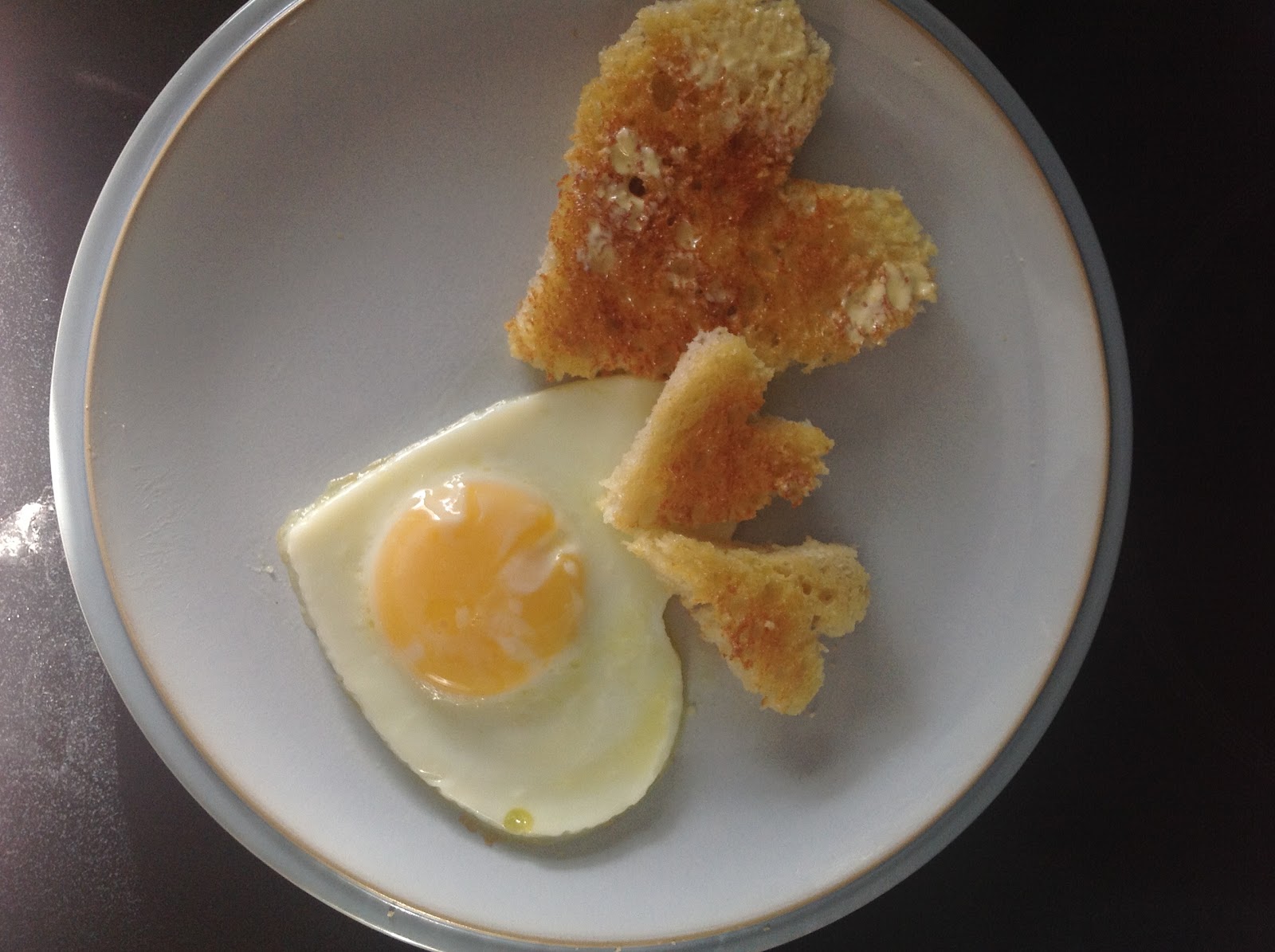
  • Cutting food into fancy shapes (eg. hearts, stars etc.) with food cutters. 
  • Leading by example - eating the food that I'd like her to eat.
  • 'Pinching' her food - this works if she like it and is just being a little bit slow.
  • Letting her 'pinch' our food - this works, if The Hub's eating Bratwurst.
  • Refusing anything else she asks for, until she's eaten properly eg. biscuits, cake, chocolate, boob  etc.
  • Going without (taking snacks instead). However, she rather likes this approach and ends up  grazing through all the snacks in my bag (eating the kinds of things that just leave you wanting more and refusing the 'healthy options').
  • Veiled threats - 'When you've had breakfast, you'll be able to go out,' ie, 'If you don't eat breakfast we won't be going anywhere!'
  • Choice - asking her to decide from a range. However, even when she chooses, she may steadfastly refuse the rest after only one mouthful - no matter how many times the food is placed back in front of her!
  • I've also tried variety - being Dairy free, does not mean you have a completely restricted diet (unless you have other foods to which you are also allergic). 
However, all to no avail! Although, to be fair, it's not that she hasn't been eating anything - it's just that she hasn't been eating as much of anything as she used to, and not enough to keep her going through the morning. Which gives the impression that I'm not quite hitting the target (as far as she's concerned) but it's not for want of trying, as we have experimented with a fair variety of foods.


So what ammunition have I been using?

To begin with:
  • Baby formula and baby rice/cereal - her first breakfast. This worked well until Hipp stopped manufacturing her favourite (dairy free) blend and then she went off Nutramigen altogether.
  • Fruit breakfast with granola (made by Plum, but it looks like it's no longer available).  We alternated between two flavours, however, it was always a bit touch and go, as to whether she'd eat them. 
  • Fruit purées of various kinds.
Next:

  • Eggy bread. I cut it into tiny squares, so she could chew them. At this stage (having no other milk than Nutramigen, or breast milk) I could hardly offer her cereal, as the Health Visitor's Assistant had insisted we should. However, I reasoned that bread was made with a cereal and egg was a good source of protein and iron, and contained some Vitamin D,* so it wouldn't be too bad for her. Also, in this form the egg wouldn't be too dry, and yet, would be properly cooked. This worked quite well for a while... then she went off eggy bread.

Since then we've tried:
Scrambled egg & toast
  • Fried egg on toast - using olive oil. She couldn't manage to eat all of it, so I concentrated on getting her to eat the yolk - that's the bit with all the iron and Vitamin D.
  • Scrambled egg on toast - using Pure Dairy Free Margarine
  • Poached egg on toast - mainly when she's had a tummy upset and can't take anything oily. We use Delia's method, as it's pretty fool proof, but you do need a timer!
  • Cereal and milk - mixture of Cheerios and Rice Krispies with Alpro Junior Plus 1 (not keen on the sugar, but...)
  • Fish Finger (Youngs Free From, but Sainsbury's also do a free from fish finger) and a Hash Brown (Mc Cains)
  • Toast with honey/jam
  • Porridge made with Alpro Junior Plus 1
  • Pancakes (made with coconut milk) - only the once to be honest (with some mixture left from Shrove Tuesday - see previous blog on pancakes). Despite a smiley face made of banana and chocolate buttons (which I thought would be a winner) pancake went down like a lead balloon (although she ate the chocolate drops)! So that idea was quickly abandoned.

What now?
Well I'm not completely stumped! I have a few more breakfast ideas up my sleeve.
Further Weapons in my Arsenal:
  • Waffles - I've steered clear of these, so far. Partly because making them is a bit involved (no suitable ready mix available that I know of) and partly because of the washing up! Cleaning waffle iron a bit of a faff too!
  • Scrambled eggs with additions - I could add smoked salmon or bacon chunks but I'm a bit worried about salt content of these.
  • Healthy Muffins - steered clear of these so far as they're a bit too much like cake (in my opinion) and there's a bit of extra effort and washing up involved.
  • The Hub's Breakfast - he doesn't always have breakfast, but at the weekend, he sometimes treats himself to sausages. Baby loves Daddy's Bratwurst!! I have to admit, there's nothing like the smell of cooking sausages to get those gastric juices working! However, I'm not sure that she should have those every day of the week!!
Hmm! Maybe I've hit the nail on the head here - with The Hub's breakfast. I have been considering recently whether, as parents, we have been setting her the best example - Hub rushing off to work, each morning, without his breakfast; me eating mine by the laptop, as I catch up on the latest...


Maybe, we should try and get back to sitting round the breakfast table together, but you should see our table - covered in my never-ending washing-to-be-sorted pile!! Speaking of which...Ho! Hum! Back to the grindstone...


Meanwhile, if you happen to think of any other ideas, maybe you could pass them our way??

*Update! Eggs have recently been found to contain twice as much Vitamin D as was previously thought! Meaning they contain two thirds Vitamin D daily requirements, so they make a really great breakfast!!

Related Post

Weaning the Dairy Free Baby - First Steps!

Further Reading:

Neocate Weaning Guide
Neocate Food Allergy Cookbook
Feeding Tips for Toddlers: from One Year (Nutramigen)

Wednesday, 2 May 2012

Weaning the Dairy Free Baby - First Steps!

There are so many things that I wish I'd learned at breastfeeding school! We only had one session and they made it appear all so easy-peasy and although I'd like to stress that I am a big fan of breastfeeding, I definitely feel that they left a few things out. One of which was when to stop!


First Step - When to stop the Breast?

The way they talked about it, I was left assuming that once you had finished your six month stint, Baby was onto solid food and off we all went - sailing into the sunset with nary a backward glance. Well they didn't necessarily give that message, but no-one discussed when or how you 'gave up' breastfeeding! 

Obviously now I know that when you give up breastfeeding is a personal choice. How you give up, I'm still not sure about - because I'm still breast feeding Baby at a time when most mothers have long since kissed goodbye to the whole affair. I did read Gina Ford's advice about replacing breast feeds with bottle feeds one at a time, but having switched to feeding on demand (in order to keep the milk flowing) I'm a bit clueless as to how you stop a demand fed baby from requesting a feed. 

Mind you, I'm not fretting over it. The reason I'm still going, is partly because I still feel I have something to give her that she can't get elsewhere; partly because she definitely still wants it and finally because I have the luxury of being at home with her. If I'd had to go back to work, it wouldn't have been so easy.

When we first discovered that Baby had a cow's milk protein allergy, at the end of her first month, I was given the option. The paediatrician was perfectly willing to write the prescription. I could there and then have switched straight onto hypo-allergenic formula and indeed Nutramigen AA was prescribed, as I was encountering problems with breastfeeding. 

However, my main reason for continuing with breastfeeding was that I was concerned about Baby's main or even only source of nutrition being some manufactured formula, which I soon discovered (when I was using it as a supplement) left strange tiny little white bumps all over the skin on her face. 

Another good reason (the way I saw it) was that I was aware that breastfeeding until six months was advised as a way of preventing food allergies arising, and, as she had one major food allergy already, I certainly wanted to do my best to prevent the development of any others!!

I had hoped that Baby would be one of the lucky ones, who grew out of her allergy fairly quickly. So I aimed to breastfeed her, until six months or until that happened. Unfortunately not having reached that particular milestone, before the magic age of six months, it was back to the special formula we'd been given, in order to introduce her to solids. 

Fortunately, we already had a formula to turn to. If you need a special formula, you will need to see a Doctor in order to be prescribed an alternative. There are several out there and professional advice is required in order to work out which is the best one for your baby. Unfortunately, finding the right formula is only the beginning, as babies can develop ideas of their own and reject it! I have heard that it can be flavoured with strawberry Nesquik, but never got around to trying this myself.


Next - Moving onto solids

To begin with, Baby seemed okay with Nutramigen mixed with her favourite baby cereal or with baby rice. There was no sign of the tiny bumps that had appeared when she had been bottle fed. I thought all was going swimmingly, until Hipp Organic thoughtlessly discontinued manufacturing her favourite cereal!! 


After that, Baby didn't seem to take to any others and eventually I gave up, as she would steadfastly refuse to accept a single mouthful! Stumped, all we could do was to offer Baby vegetable or fruit purées instead - fortunately discovering one that was bulked up with a bit of granola, which made it a bit more filling. But I was concerned that Baby might be missing essential vitamins/minerals that were only available through cow's milk and I knew that I really needed a little more professional help/advice.


Getting professional advice

Not having weaned a Baby before (let alone one that couldn't have what everyone else seemed to be having) I wanted to ensure that I was properly prepared for weaning, especially as she was still unable to tolerate cow's milk. I knew that this was still the case, because of breaches in my diet that had led to a return of the familiar symptoms. Thankfully, our GP responded swiftly to my request to be referred a dietitian. Unfortunately, some people seem to have real problems with this process and have to battle it out.

In the meantime, I read books, magazines etc. and attended local Health Visitor led sessions. I did wonder (as some people advocate baby led weaning) whether we needed to be in too much of a hurry, but it was from the Health Visitor that I learned (shock, horror) that breast milk did not contain sufficient iron for a growing Baby! 

In fact the iron content of breast milk drops from the age of six months. Formula milk is specially fortified, of course, but the ideal thing is to get them onto iron-rich foods, like meat, fairly quickly. Something else, then, that they neglected to tell me in breastfeeding school!

However, the Health Visitor was, unfortunately, not all that well equipped to help much with the dairy free aspect of weaning. I was a bit disappointed with the Health visitor's lack of knowledge, especially when you think that 2% or 3% babies will experience problems with cow's milk. In fact, there were at least two other woman in our village (whose babies were the same age as mine) who also suffered from the same problem.  It was just as well, therefore, that Baby and I had the appointment with the Dietitian lined up.

The Dietitian was excellent, she offered advice on weaning Baby, but didn't neglect me as a breastfeeding mother. The Dietitian was also able to offer me another alternative, when I mentioned Baby's lack of enthusiasm for Nutramigen. She told me that babies start to develop the ability to detect bitter tastes around six months of age. This was actually very useful, when our ancestors were hunter gatherer types, because bitter plants are often poisonous. However, breast milk is very sweet apparently and Nutramigen not so. No wonder Baby rejected it - she's obviously inherited my sweet tooth! 

The Dietitian's answer was to try another formula. This one, PaediaSure Peptide, I plucked up the courage to try myself. It was vanilla in flavour but left a dry chalky feeling on my tongue and made me feel thirsty. Not surprisingly, Baby rejected this one too! For her, only breast milk would do! 


Alpro Junior Plus 1 has a lot in it!
More recently, this has begun to change - now she's that bit older we have introduced her to Alpro Junior Plus 1. I was hesitant at first, partly due to my own intolerance to soya milk, but also because there have been health concerns about soya milk. Baby enjoys this as a milk drink and has had it on cereal, although she prefers her cereal dry! As it is fortified with essential vitamins and minerals, there is less worry about lack in her diet. However, she still really prefers the Boob!

Prepared to support my decision to breastfeed, the Dietitian quizzed me carefully, to find out how often and for how long Baby was breastfed. She checked to make sure I was getting enough calcium and then she dropped another bombshell - Breast milk contained very little Vitamin D and therefore baby was going to need drops. Why didn't they teach that one in Breastfeeding School?

We were recommended to use Abidec - they produce vitamin drops for infants as well as children and are quite widely available. However, be warned! The infant drops are made with peanut oil and although the manufacturers remove the protein, Baby seemed to develop a reaction to them. 

It took some time to for the reaction to develop and longer to work out what was causing the problem. This reaction is, I believe, most unusual. Now that Baby is over the age of one, we could use Abidec's other drops which are fish-based, but we haven't tried those  just yet. It was just as well that we heeded another piece of advice, which was to completely avoid nuts altogether, even peanut butter, which was just as well considering what was to come further on down the line. 

The problem is, if a baby has a food allergy, there is the possibility that there may be more lurking. I had been warned to be careful to introduce one thing at a time - even with spices. Each new food was to be given four or five days in a row, in case it took a while for an allergic reaction to develop. 

Concerned that Baby might not get enough calories, as she wasn't having cow's milk, the Dietitian advised adding an extra spoonful of oil to Baby's portion of food. To be honest, I didn't really follow that piece of advice, too much, because Baby has a healthy appetite and apart from her first month of life has never particularly looked like she was wasting away!

In fact, Baby has done so well that my only other concerns have been over the fairly limited diet that Baby preferred to stick to, for quite a while and the fact that she wasn't eating her five-a-day. For ages, Baby only seemed to like fried egg for breakfast and lunch - not a whole one (I hasten to add) we mostly stuck to the yolk, as that was the bit she liked! However, the Dietitian was able to run through Baby's diet with me, was happy that she was getting the right nutrients and told me not to worry too much about that famous five-a-day. Babies, it seems, need much less fibre than adults. 


Only fried egg would do!
Knowing that has made me able to relax and discover that Baby, (given time, and provided with good healthy options) is actually fairly instinctive about what she needs - if she majors on one food group at one meal, she usually stocks up on others later. When a cold is brewing, like me, she suddenly craves juice! So apart from the early stages, when food needed to be introduced carefully, we have tended to go with the flow. 

We've gone for more of a 'Baby-led Weaning' approach - we tend to prepare food for ourselves that we know is suitable for her (avoid sugar and salt, as well as dairy, if you do this) which means much less stress all round. The only problem is, anything that's ours, is now fair game for her. 'I'm very clever at sharing,' she said happily the other day... as she helped herself to my lunch!!!


Update! 

Eggs, it turns out are even more brilliant than I realised. Researchers have recently found that eggs contain twice as much Vitamin D as was previously thought! Meaning they contain two thirds Vitamin D daily requirements!! Great news, for those who can have it!

These more recent posts may be useful for anyone wondering which dairy free milk is best:

Which dairy free milk is best?

Finding the perfect formula for the Dairy Free Baby


Further Reading:

Neocate Weaning Guide
Neocate Food Allergy Cookbook
Weaning and up to One Year
Feeding Tips for Toddlers: from One Year (Nutramigen)
Cow's Milk Free Weaning Diet (Norfolk NHS)